Research theme · 01
Quantum dynamics and non-equilibrium physics
Geometric approaches, many-body dynamics, and the physics of ensembles in complex quantum systems.
How do complex quantum systems evolve, and which features of their microscopic dynamics determine their collective behavior? We approach these questions through geometry, information theory, and the physics of ensembles.
Our focus includes many-body systems away from equilibrium and open quantum systems interacting with structured environments. The directions below connect mathematical descriptions of quantum states to concrete questions about dynamics and statistical behavior.
Research direction · 01
Geometric quantum mechanics
Geometry offers a different perspective on quantum states and their evolution. We use this perspective to study the information and structure carried by complex quantum systems.
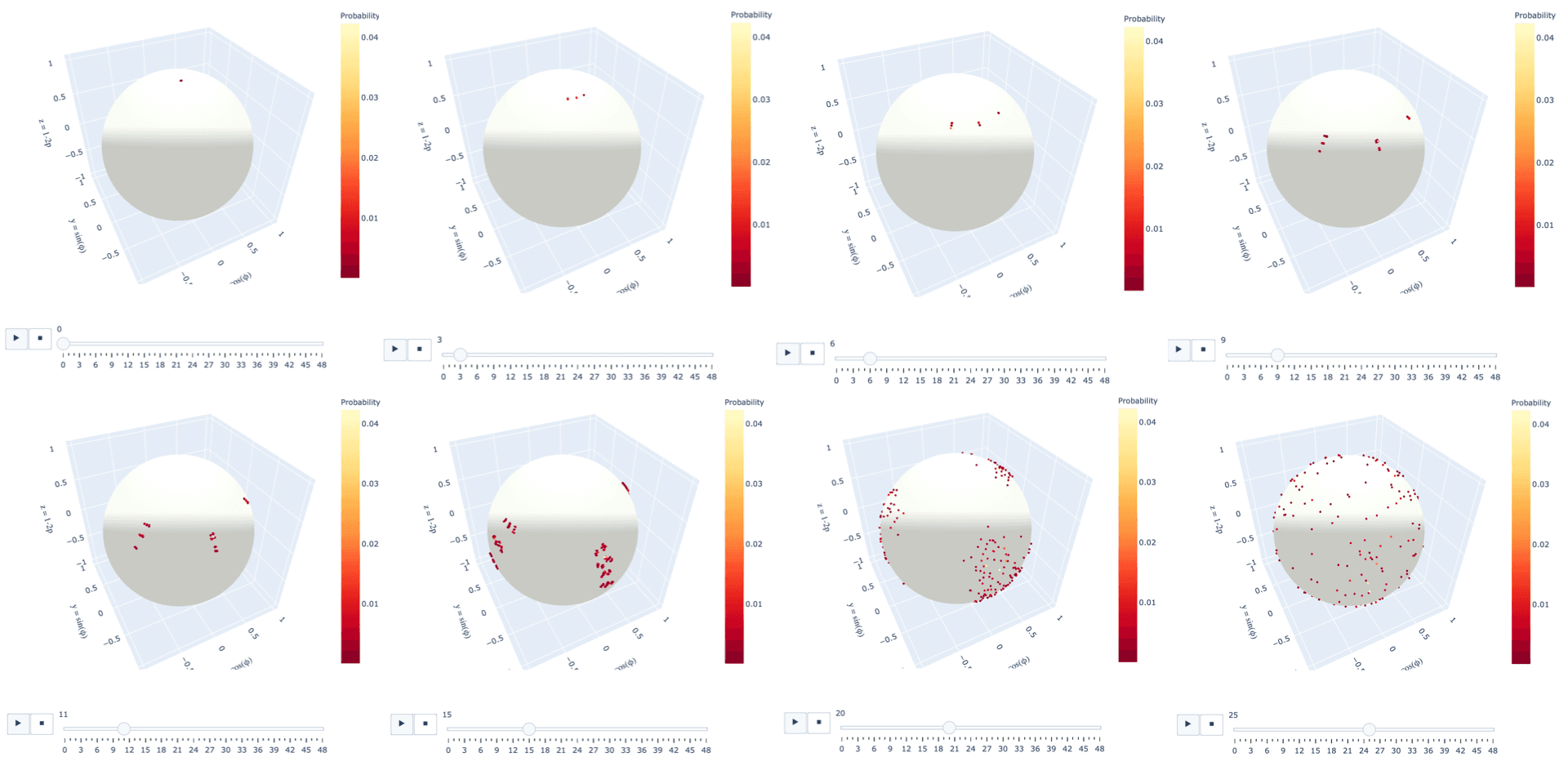
In geometric quantum mechanics, pure states are points of the complex projective space , while a geometric quantum state is a probability distribution on that space. This brings tools from differential geometry and dynamical systems into the study of quantum physics.
Papers in this direction
2026
Probability-phase mutual information
C. Hahn, N. Ranabhat, F. Anza
Physical Review A 113 (6) (2026)
2022
Quantum Information Dimension and Geometric Entropy
F. Anza, J. P. Crutchfield
PRX Quantum 3 (2) (2022)
2021
Beyond density matrices: Geometric quantum states
F. Anza, J. P. Crutchfield
Physical Review A 103 (6) (2021)
Research direction · 02
Non-equilibrium many-body dynamics
How do information, correlations, and entropy evolve in interacting quantum systems? We investigate the dynamics of complex quantum systems, including how they approach equilibrium and when they retain memory of their initial conditions.
Research in this direction connects quantum information transport, many-body localization, and the information-processing resources embedded in physical dynamics.
Papers in this direction
2021
A kinetic theory for quantum information transport
F. Anza
arXiv:2106.00385 (2021)Preprint
Quantifying the Difference between Many-Body Quantum States
D. Girolami, F. Anzà
Physical Review Letters 126 (17) (2021)
2020
Logarithmic growth of local entropy and total correlations in many-body localized dynamics
F. Anza, F. Pietracaprina, J. Goold
Quantum 4 250 (2020)
2018
Eigenstate Thermalization for Degenerate Observables
F. Anza, C. Gogolin, M. Huber
Physical Review Letters 120 (15) (2018)
Research direction · 03
Physics of ensembles
Ensembles connect microscopic quantum descriptions to statistical predictions. We study how to characterize ensembles, identify the information needed to describe them, and understand the role of constraints in equilibrium and non-equilibrium physics.
This direction brings together geometric entropy, quantum thermodynamics, and observable-based descriptions of statistical mechanics. It connects directly to our research on the quantum foundations of thermodynamics.
Papers in this direction
2025
Non-classicality at equilibrium and efficient predictions under non-commuting charges
L. Scarpa, N. Ranabhat, A. Te'eni, A. Alhajri, V. Vedral, F. Anza, L. P. García-Pintos
arXiv:2507.22882 (2025)Preprint
Observable Statistical Mechanics
L. Scarpa, A. Alhajri, V. Vedral, F. Anza
arXiv:2309.15173 (2025)Preprint
2024
Maximum Geometric Quantum Entropy
F. Anza, J. P. Crutchfield
Entropy 26 (3) 225 (2024)
2022
Geometric quantum thermodynamics
F. Anza, J. P. Crutchfield
Physical Review E 106 (5) (2022)
Szilard Engines as Quantum Thermodynamical Systems
M. Ashrafi, K. J. Ray, F. Anza, J. P. Crutchfield
arXiv:2010.14652 (2022)Preprint
2018
New Equilibrium Ensembles for Isolated Quantum Systems
F. Anza
Entropy 20 (10) 744 (2018)
2017
Information-theoretic equilibrium and observable thermalization
F. Anzà, V. Vedral
Scientific Reports 7 (1) (2017)